
Inventory Twin
A unified, real-time view of inventory across warehouses, in-transi shipments, and yards.
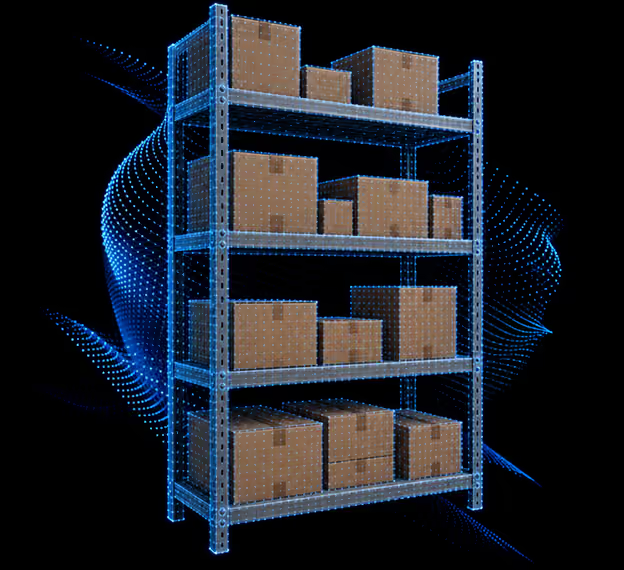
Inventory is the most expensive asset most companies carry, and also the hardest to model accurately. Your ERP shows what was received and what was issued. Your WMS shows what is on the shelf. Your TMS shows what is in transit. Your YMS shows what is in the yard. But no single system combines these into one unified picture of your actual, real-time inventory position across every location in your network.
The Inventory Twin solves this by creating a continuously updated digital replica of your inventory: not just what you have today, but what you will have tomorrow, next week, and in two weeks. It connects to all three sibling twins. The Order Twin tells it what is on order. The Shipment Twin tells it what is in transit and when it will arrive. The Facility Twin tells it what is in the yard, what has been received, and what has been staged.
On top of that unified position data, the Inventory Twin runs predictive analytics: stockout risk detection 7-14 days in advance, excess inventory identification, safety stock recommendations calibrated to actual supply variability, and AI-powered replenishment recommendations that can execute automatically through Digital Workers and system integrations.
Supply Chain Objects Modeled
- Inventory Position: A SKU at a location with a quantity, updated in real time. Spans warehouse bins, DC zones, in-transit shipments, yard trailers, and receiving docks. Carries batch/lot identification.
- SKU / Material: Product identifier with description, unit of measure, commodity class, temperature requirements, hazmat classification, shelf life, and value.
- Location: Any place inventory can exist: warehouse bin, DC, yard staging area, in-transit container, or supplier facility. Identified by GLN for facility-level positions.
- Stockout Risk: A predicted event where a SKU at a location reaches zero before replenishment arrives. Detected 7-14 days in advance using current position, consumption rate, inbound ETAs, and demand signals.
- Replenishment Recommendation: AI-generated action: internal stock transfer, alternate DC fulfillment, supplier expedite, or network-wide rebalancing.
- Inventory Projection: Forward-looking view by SKU and location. Combines current positions with expected inbound (shipments, POs) and expected outbound (SOs, forecasted demand).
Execution Systems Ingested
- ERP: On-hand inventory, goods receipts, goods issues, safety stock parameters, and reorder points from your ERP system.
- WMS: Bin-level positions, cycle counts, picking confirmations, and receipt processing from your WMS.
- Order Twin: Open POs as future supply. Open SOs as future demand. STOs as internal rebalancing.
- Shipment Twin: In-transit positions and arrival predictions. Converts ETAs into expected receipt dates at destination.
- Facility Twin: Yard inventory (staged but not received), receiving confirmations, dock-level receipt timing.
- IoT Sensors: RFID labels for bin-level accuracy, temperature sensors for cold chain, automated cycle counting.
When you need this Twin
- Your ERP inventory reflects yesterday, not what is in transit, in the yard, or at risk. Planning decisions are made on stale data.
- Stockouts are discovered when a customer order fails or a production line stops, not days earlier when corrective action was still cheap.
- Excess inventory accumulates because planners over-buffer to compensate for poor visibility into actual arrival timing. Carrying costs consume 20-30% annually.
- Multiple warehouses and DCs lack a unified view. One DC has surplus while another faces shortages of the same SKU.
- Regulatory requirements (DSCSA for pharma, cold chain for food, hazmat for chemicals) demand real-time lot-level traceability your current systems cannot provide.
- "Phantom stock" distorts records. The ERP says 500 units, but 200 are in an unreceived yard trailer, 50 were consumed but not scanned, 30 are damaged.
Core Capabilities
Capability | Description | |
Unified Inventory Visibility | Single view across warehouse, in-transit, yard, and pending receipt. Batch/lot tracking with configurable projections. | |
Predictive Stockout Alerts | AI-powered risk detection 7-14 days in advance. Prioritized by revenue impact and customer importance. | |
AI Replenishment Recommendations | Four strategies: internal transfer, alternate DC fulfillment, supplier expedite, network-wide optimization. | |
Automated Execution | Recommendations trigger booking, carrier selection, and shipment creation via PO Connect and Digital Workers. | |
Industry-Specific Capabilities | Pharma (cold chain, DSCSA), F&B (temperature, perishability), Retail (omnichannel, ship-from-store), Automotive (JIT, line-down prevention), Chemicals (hazmat). | |
IoT-Enhanced Accuracy | RFID, smart sensors, automated cycle counting, real-time consumption detection. Eliminates phantom stock. | |
Frequently Asked Questions
One billion hours of operational work completed by AI agents over the next decade.