Your supply chain has SOPs. Your AI workforce has AOPs.
Agent Operating Procedures are the executable playbooks that tell your Digital Workers exactly how to handle every situation: which data to gather, which intelligence to consult, which action to take, and when to escalate. Natural language flexibility with coded logic precision, powered by the Graph.

Decision trees are brittle.
Prompt engineering is fragile. AOPs are neither.

Rigid decision trees handle the 80% you anticipated and break on the 20% you didn't. Every edge case requires a developer and a deployment cycle. Prompt engineering gives you unpredictable outputs at the margins: hallucinated carrier codes, misinterpreted detention policies, wrong escalation emails, no audit trail.
AOPs are the third option
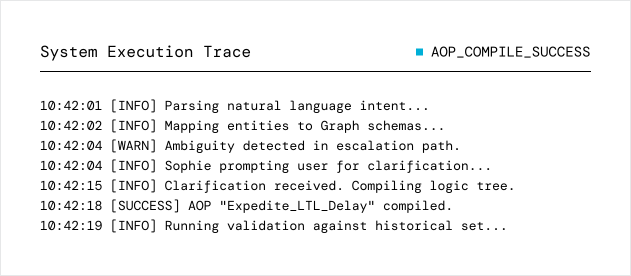
Natural language instructions that compile into deterministic, auditable, executable logic. You describe the process. Sophie builds the procedure. Every step defined. Every decision point explicit. Every outcome traced.
Describe the process. Sophie builds the playbook. The agent follows it. The Graph informs every step.

STEP_01
Describe Requirement
When an inbound shipment is more than 2 hours late to a JIT facility, contact the carrier, assess root cause, and if the delay impacts production, escalate to the plant manager and trigger a stock transfer from the nearest DC.

STEP_02
Sophie Generates
Sophie translates your requirement into a structured procedure with defined trigger conditions, data gathering steps, intelligence consultation (what to ask the Graph), decision logic, execution steps, escalation rules, and outcome recording.

STEP_03
Test & Validate
The AOP runs against 10-20 historical exceptions from your actual shipment data. Not synthetic tests. Validation against your own operational history.

STEP_04
Deploy to Prod
One click to live. The Agent Performance Dashboard tracks every execution in real time.
The orchestration platform where agents operate, workflows are built, and every decision is recorded.
Loft is the operating environment for the FourKites Digital Workforce (Tracy, Sam, Alan, Cassie, etc.). It ensures every action is secure, audited, and optimized.
ISOLATED SYSTEM LOGIC
An AOP without the Graph
> "This shipment is late. Contact the carrier."
ISOLATED SYSTEM LOGIC
An AOP without the Graph
> "This shipment is late.
> [GRAPH_QUERY] The carrier is late 34% on this lane in Q4.
> [ROOT_CAUSE] is typically a facility bottleneck at origin.
> [RESOLUTION_PATH] with 78% success rate: contact dispatcher directly.
> [IMPACT] Downstream impact: 3 POs, $1.2M.
> [AGENT_ACTION] Alan has rescheduled. Cassie on standby."
> [GRAPH_QUERY] The carrier is late 34% on this lane in Q4.
> [ROOT_CAUSE] is typically a facility bottleneck at origin.
> [RESOLUTION_PATH] with 78% success rate: contact dispatcher directly.
> [IMPACT] Downstream impact: 3 POs, $1.2M.
> [AGENT_ACTION] Alan has rescheduled. Cassie on standby."

Custom AOPs
When your process doesn't fit a template, Sophie builds it. 80% proven network pattern. 20% your rules. Same Build, Test, Deploy lifecycle.
Pre-built AOP Library
Validated across Fortune 500 deployments, refined from thousands of real outcomes.
Tracy contacts carrier, investigates root cause, resolves or escalates. Validated across 39 production shippers.
Alan creates dock appointments based on Shipment Twin ETAs and facility capacity.
Custom AOPs
When your process doesn't fit a template, Sophie builds it. 80% proven network pattern. 20% your rules. Same Build, Test, Deploy lifecycle.
Enterprise-grade security. Full chain of custody. Your data stays yours.
Federated data architecture: your data is segregated from every other customer. Network intelligence is aggregated and anonymized. Customer data is never used to train third-party models.


One billion hours of operational work completed by AI agents over the next decade.
The supply chains that adopt autonomous execution in the next 24 months will define the competitive standard for the next decade. The ones that do not will spend that decade trying to catch up.
Ready? Talk to an Outcome Advisor