Building an agent is 20% of the problem. Running it at enterprise scale is the other 80%.

This page is for the technical buyer. How Loft connects to your systems, reaches the physical world, proves every decision, monitors performance, and gets smarter over time. Five sections. The full production story.

Talk to an Outcome Advisor

Loft connects to the systems your supply chain already runs on.

Bidirectional: agents read from your systems of record and write results back. No middleware. No CSV uploads.

ERP: Major ERP platforms. PO data, status updates, goods receipts, via standard APIs and messaging interfaces.
TMS: Leading transportation management systems. Shipment creation, carrier assignment, ETA updates.
WMS: Warehouse management systems. Dock assignments, goods receipt, inventory positions.
OMS: Order management systems. Order status, fulfillment, allocation, OTIF measurements.
Carrier Systems: {{carriers}}K+ carriers via API, EDI, email, SMS, mobile tracking, ELD, voice. The Graph knows each carrier's preferred channel.
IoT: RFID, temperature sensors, GPS yard tractors, gate cameras (AutoGate). Real-time signals feed the Facility Twin.

Integrations are plumbing.

Intelligence is what flows through them. When Loft receives a PO, the Order Twin immediately links it to carrier performance, lane distributions, and supplier reliability from the Graph. The PO becomes a live object enriched with {{years}} years of intelligence the moment it enters.

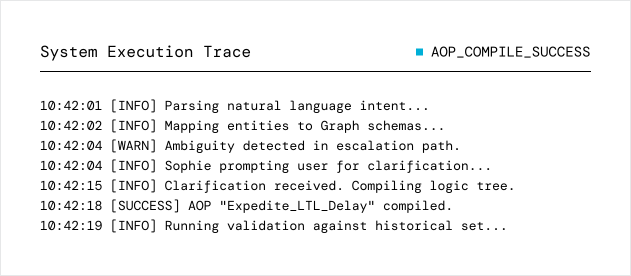
Meet Sophie: the agent that builds agents

{{communication-channels}} channels. Every touchpoint your supply chain depends on.

Primary enterprise supply chain channel. Tracy emails carriers with Graph context: carrier history on this lane, likely root cause, specific info needed. Carriers respond because the email is specific, not generic.

FourSight Gen UI draws on the Graph to generate persona-specific views. The VP sees revenue at risk. The coordinator sees exceptions. The dock supervisor sees the next 4 hours.

Real-time carrier interaction at scale. How Loft reaches {{carriers}}K+ small carriers without portals or APIs. Carriers respond to a text in minutes. They ignore a portal login for hours.

Native supply chain protocol: EDI. The channel that only exists in supply chain. The Graph tracks carrier EDI compliance; when a carrier fails to send timely EDI updates, Tracy switches to SMS.

Direct machine-to-machine integration. Agents push updates into ERP, TMS, WMS. API updates enriched with Graph intelligence: not just 'delayed' but root cause, revised ETA, impact, and resolution action.

Human-like carrier conversations when email and SMS go unanswered. The agent knows the carrier's dispatch hours, the right number, and the specific information needed. Targeted, not cold.

Every decision has a record. Nothing happens in a black box.

When your board asks 'how is AI making decisions in our supply chain,' the Decision Trace is the answer.
DECISION TRACE
Step-by-step record
> Trigger: What event started the workflow.
> Data Gathered: What information the agent collected from which Twins.
> Intelligence Consulted: What the agent asked the Graph.
> Decision Made: What the agent decided and why.
> Action Taken: What the agent did and which channels it used.
> Response Received: What came back from the carrier, supplier, or system.
> Outcome Recorded: Final result, fed back into the Graph.
DECISION TRACE
Why This Matters
> Trust: Every agent action explainable. 'Tracy used Resolution Path B because the Graph showed 78% success rate for this pattern.'

> Compliance: SOC 2 Type II and ISO 27001 require audit trails for automated decisions. The Decision Trace is that trail. Exportable. Queryable.

> Continuous Improvement: Traces feed back into the Graph. The system learns what works by carrier, lane, exception type, and season.

Know exactly what your workforce is doing. At all times.

01 / Analyze

Agent Performance Dashboard

Per-agent, per-customer, per-workflow metrics. Which workflows are succeeding, which are failing, and why.
02 / Monitor

Workflow Health

Each active AOP has a health score. When it drops below threshold, Loft flags it and Sophie proposes diagnostic analysis.
03 / Detect

Anomaly Detection

Sudden spike in escalation rate. Drop in resolution success. New exception pattern the AOPs don't cover. Anomalies surface before they become complaints.
04 / Compare

Cross-Customer Benchmarks

Anonymized performance from 882 enterprise shippers. How does your resolution rate compare to the network average?

Every decision makes the next decision better.

The compounding advantage that separates Loft from every DIY build and every horizontal agent platform. Loft does not just execute. It learns.
STEP_01

Data enters the Graph

Every shipment, facility visit, carrier interaction, global signal. {{loads}} million loads and growing.
STEP_02

Intelligence is derived

Lane distributions, carrier patterns, facility benchmarks, disruption taxonomies, resolution success rates.
STEP_03

Agents act on intelligence

Tracy, Sam, Alan, Cassie, Polly, Didi, Becca execute. 2.5 million actions per month.
STEP_04

Decisions feed back to the Graph

Full decision trace: inputs, intelligence, action, outcome.

Three Compounding Layers

The flywheel has an 11-year head start. A competitor can build an agent platform in months. They cannot build the flywheel in months.

Within a single customer

Your agents learn your patterns: which carriers respond to SMS vs. email, which facilities have tight dock windows, which lanes have the widest gap between planned and actual transit.

Across the FourKites network

Anonymized patterns from 882 shippers. New customers don't start from zero. They start with the collective intelligence of the entire network.

Across the intelligence layer

Global signals compound too. Agents that operated during January ice storms learned patterns that make the next winter storm response faster.

Enterprise-grade security. Full chain of custody. Your data stays yours.

Federated data architecture: your data is segregated from every other customer. Network intelligence is aggregated and anonymized. Customer data is never used to train third-party models.
Visit the Trust Center
SOC 2 Type II

One billion hours of operational work completed by AI agents over the next decade.
The supply chains that adopt autonomous execution in the next 24 months will define the competitive standard for the next decade. The ones that do not will spend that decade trying to catch up.
Ready? Talk to an Outcome Advisor
Talk to an Outcome Advisor
Explore Outcomes