Doing more with less: Tackling Europe’s supply chain challenges

Supply deficits. Factory and port closures. Border chaos. These are challenges that most countries around the world are experiencing. However, in Europe – especially in the UK – supply chain issues could persist beyond 2022.
Underpinning it all is a labor shortage, particularly a shortage of drivers. As The Journal of Commerce reports, “The UK Road Haulage Association said the driver shortage could be as high as 100,000, while the International Road Transport Union (IRU) anticipates Spain will see more than 20,000 truck driver jobs unfilled this year. Germany is battling with a shortage of 65,000 heavy goods vehicle drivers, and France is estimated to have a shortage of up to 50,000 drivers, the IRU found.”
Indeed, over the last several months, FourKites platform data shows a decline in full truckload shipments in the UK. This is problematic when you consider that, according to the State of the European Supply Chain: Logistics, Sustainability and Visibility Report 2022, 74% of European companies use full truckload as their primary mode of transportation.
So, what are shippers to do?
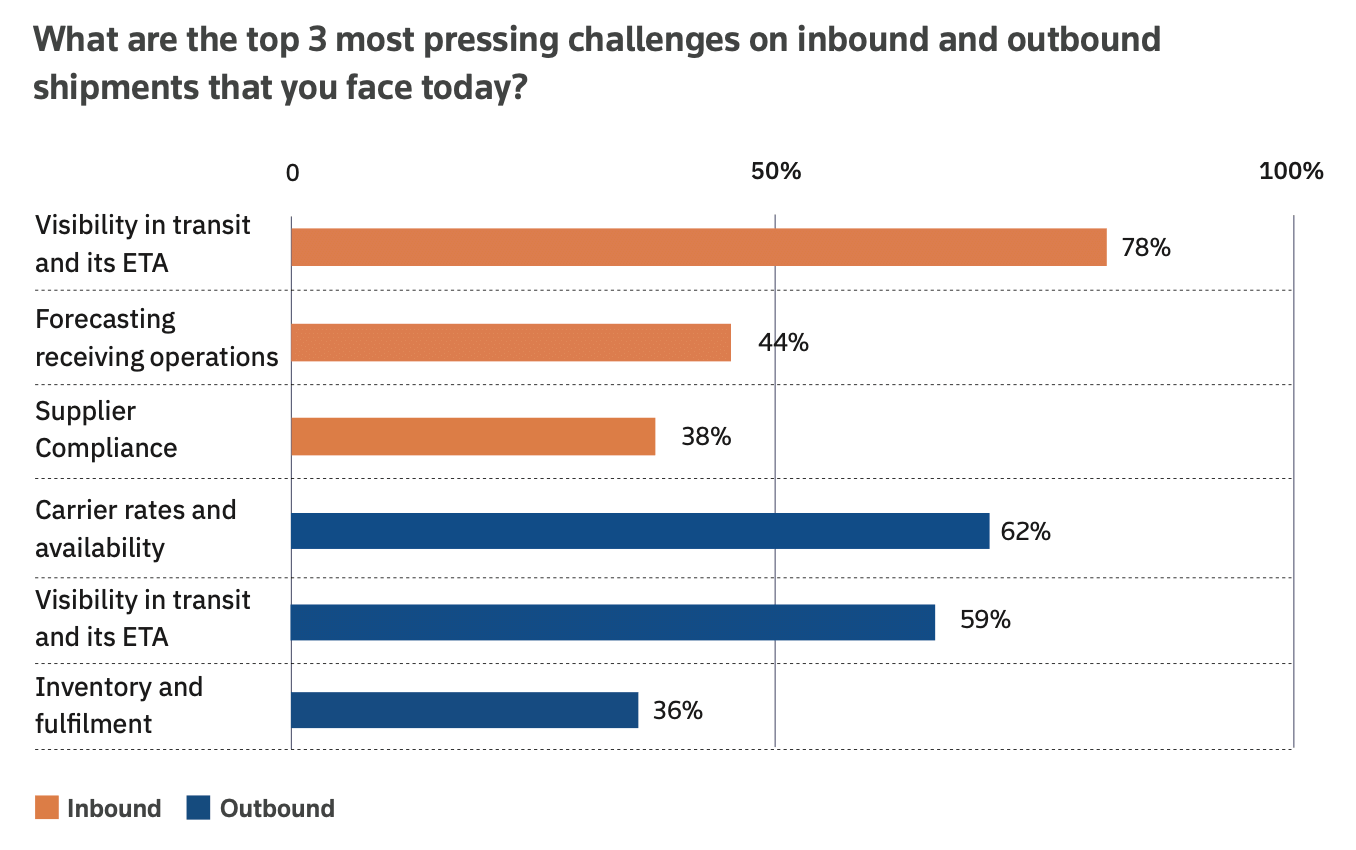
Start with real-time visibility. The latest research from Reuters and FourKites found that European supply chain leaders consider visibility and accurate ETAs as a pressing challenge for both inbound (78%) and outbound shipments (59%).
Rather than hope carriers and politicians can solve the issue, shippers can leverage real-time data to wrest some control and make the most of the capacity that’s available.
Supply chain visibility helps in more efficient planning of deliveries. It enables less dwell time at pickup and delivery locations for drivers; it can eliminate empty kilometers; and shippers can plan more efficiently and connect trucks with loads better.
For example, as we recently shared with trans.info, appointment scheduling for shippers and truckers has historiy been time-consuming, largely manual and extremely inefficient. Shippers who leverage real-time visibility combined with a tool like FourKites Appointment Manager can solve these issues by providing one universal interface for shippers and carriers across the supply chain to schedule appointments. Additionally, allowing easier and faster flow of transportation documents and streamlining communication with dispatchers save precious minutes that, over time, add up. As a result, drivers save significant time while simultaneously improving daily operations and relationships with clients.
And the utility of real-time visibility is not limited to improving the efficiency of your supply chain. In reality, better data and planning can enable fruitful collaboration among stakeholders. By using predictive capacity management tools, manufacturers can work with other manufacturers and retailers who share common lanes to improve utilization.
. . . . . . . . . . . . . . . . . .
By taking full advantage of real-time data and being willing to collaborate with our network and beyond, we can better utilize what we have and spend less time worrying about what we do not. As supply chain disruptions continue into 2022 and beyond, this notion will help the entire ecosystem remain agile and responsive through even the most difficult circumstances.
Download the full report to learn more about the current state of the European supply chain.
Thank you for your submission!